

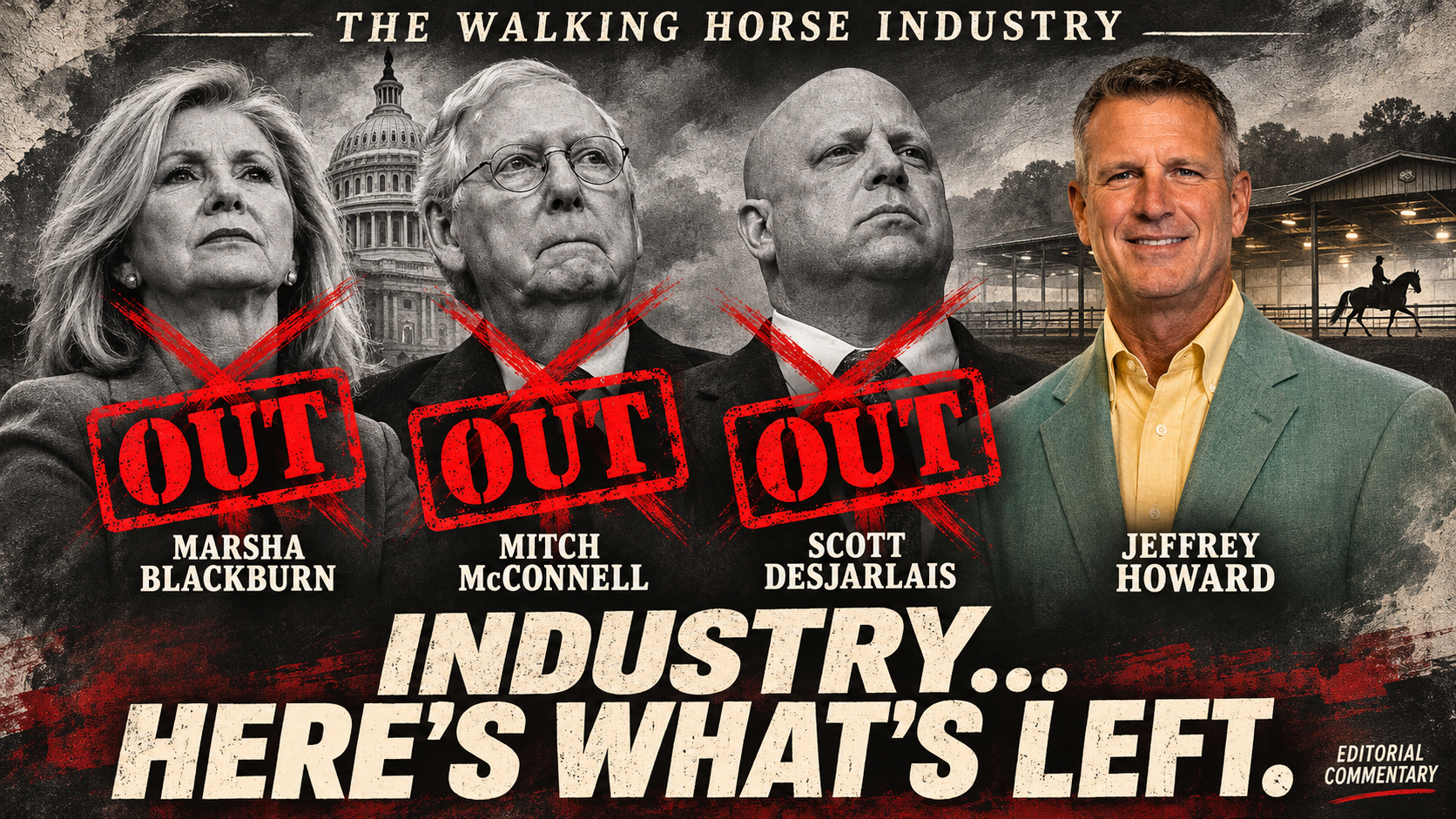

FAST Bought Time. Who Pays When the Political Protection Runs Out?
Jeffrey Howard, Kasey Kesselring, TWHBEA and SHOW owe the people financing this fight an accounting of its costs and a credible plan for what comes next.
By Tommy Williams, Publisher of WalkingHorseChat.com
Opinion | November 7, 2026
The walking horse industry has learned how to pass the hat. It is time to pass around the ledger. FAST and the organizations backing this prolonged regulatory fight should explain what the money has purchased, what risks remain, and who carries the loss if the political protection runs out.
Jeffrey Howard, Kasey Kesselring, TWHBEA and SHOW belong in that accounting. Their documented roles differ, but each has helped promote, finance or administer the coordinated defense of the existing system. The people paying for it are entitled to ask whether they are financing a durable future or another round of uncertainty.
Start with the industry’s own disclosure. TWHBEA says SHOW again required horse and exhibitor cards for 2026, that TWHBEA administers the program, and that those cards raised $714,000 over the preceding two years for industry legal expenses. That is a concrete cost of participation attached to a legal strategy. It deserves scrutiny as serious as the fundraising appeal. [1]
FAST’s legal-campaign page, carrying a March 2025 update, separately reports industry legal fees exceeding $2 million and an expectation, stated as of January 1, 2025, of another $1 million to finish the effort. Those historical figures are FAST’s account, not a current audited total. They must not be added to the card receipts: the funding streams may overlap. Nevertheless, they establish the scale of the campaign in the organization’s own telling. [2]
The lawyers have obtained meaningful relief. USDA acknowledges that the court vacated the 2024 rule’s prohibitions on pads and action devices. People defending that equipment can fairly call that a consequential win. The question is what leadership did with the time and operating room it preserved. [3]
Winning a lawsuit is an achievement. Converting the time it buys into a viable future is the leadership test. Every victory announcement should have a business plan attached. A barn cannot pay its feed bill with a favorable press release.
Jeffrey Howard has been an identifiable public advocate of the coordinated effort. In his December 19, 2024 update, he described the organizations’ alignment, encouraged further contributions and expressed optimism about the horse’s future. He also expressly declined to guarantee victory. Criticism should address the strategy he promoted, rather than invent a promise he did not make. [4]
Kasey Kesselring is identified on FAST’s current website as its president. That position carries responsibility for explaining the foundation’s priorities and results. FAST also lists research, education, scholarships and show development among its activities. The public record therefore does not justify pretending that every FAST dollar went to lawyers. The proper demand is a clear comparison of legal spending, measurable benefits and investment in the breed’s future. [5] [6]
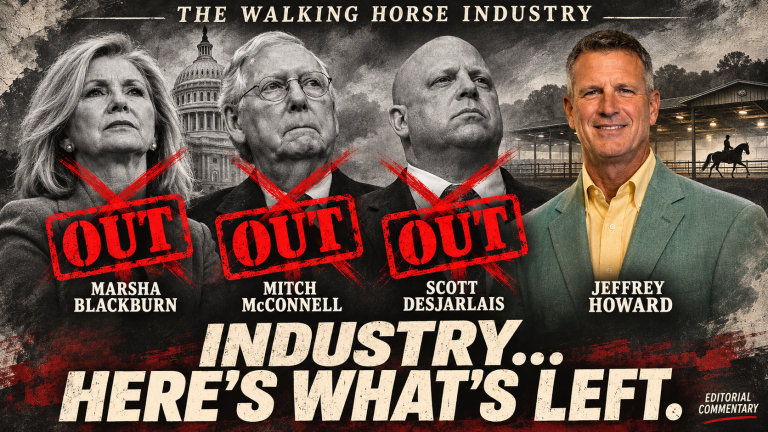
That comparison becomes urgent when political protection changes hands.
McConnell’s retirement was foreseeable. He announced in February 2025 that his current Senate term would be his last. Retirement is a different fact from withdrawing support for the industry; the evidence reviewed does not establish such a withdrawal. But a strategy dependent on an influential senator should have had a succession plan long before his departure. [7]
Blackburn’s move toward the Tennessee governor’s office changes her role, too. WPLN reports that she won the governor’s race and intends to remain in the Senate until she is sworn in as governor. She has not already lost every avenue of influence. Once she leaves the Senate, however, the governor’s office gives her no Senate vote and no power to dictate federal HPA enforcement. Personal access to Nashville cannot substitute for authority in Washington. [8]
DesJarlais requires equal precision. The election reporting reviewed on November 7 still lists his race as unresolved; a finished account should not announce his defeat prematurely. His 2025 introduction of the Protecting Horses from Soring Act, H.R. 1675, documents his support for an alternative regulatory approach. Whether he returns or departs, one representative cannot guarantee that approach becomes law. [9] [10]
Reuters reports that Democrats have won control of the next Congress. The transfer occurs when the new Congress begins in January, rather than instantly on election night. That changes the political setting for industry advocacy. It does not enact the PAST Act, replace the administration running USDA or decide pending court cases. [11]
In my judgment, these changes expose the central danger of treating political relationships as permanent protection. Politicians retire, change offices and lose elections. Those are ordinary events. An industry that collects extraordinary sums to manage federal risk should have an answer for every one of them.
SHOW brings that argument directly to the barn aisle. An HIO participates in a system intended to identify sore horses and keep them out of competition. Its credibility matters to owners who need reliable inspections, to managers running shows and to the public asked to trust the results.
The 2021 National Academies review identified inadequate DQP examination practices and potential industry conflicts of interest. It recommended discontinuing the existing DQP inspection arrangement, or using appropriately qualified third parties trained by APHIS and screened for conflicts. The report also criticized restrictive aspects of USDA’s own examination protocols. Its findings support an independent, competent inspection system and scrutiny of both sides. [12]
Those findings concern the wider inspection structure. They do not establish that every SHOW inspector performed improperly, that every padded horse was sore, or that any named individual in this editorial committed abuse. Responsibility must follow evidence. Yet an organization defending the HIO model should explain how it has answered the weaknesses identified in that model.
SHOW’s connection to required legal-funding cards raises an additional governance question: what safeguards keep inspection decisions independent from the commercial and political campaign surrounding them? Combining those activities does not, by itself, establish unlawful conduct. It does make transparent rules, financial reporting and independent review reasonable demands.
The damage assessment should begin with what can be documented. Card payments, donations and legal expenditures can be reconciled. Claims about lost buyers, reduced horse values, departing sponsors or missed opportunities need records and a credible explanation of causation. This editorial has no evidence establishing a dollar amount for those alleged losses, or attributing them to a particular defendant.
That distinction matters. A contribution to litigation is a cost; it does not automatically become recoverable damages. A disappointing strategy does not automatically establish negligence. Any civil claim against SHOW, FAST, an association or an individual would need a recognized legal basis and proof connecting that defendant’s conduct to recoverable harm. The material reviewed does not establish that case. Accountability, however, does not have to wait for a summons.
The people paying into this campaign deserve to know how much it collected, how much it spent, what obligations remain and how its results are being measured. Fundraising totals tell us how much support leadership can mobilize. They do not tell us whether the underlying business is becoming safer. The test is what owners can still do when the courtroom victory party is over.
TWHBEA has a particular responsibility here because its constituency extends across the breed. Administering a legal-funding program makes it reasonable for members to ask how that commitment fits alongside registration services, youth participation, recreational riding and broader market development. A breed association should be able to explain the benefit to the whole breed without requiring members to take the explanation on faith.
And what about the question every performance-horse owner wants answered: when do the pads and action devices come off?
There is no verified date for a blanket ban in the sources reviewed as of November 7, 2026. USDA says the 2024 equipment-ban provisions were vacated. Its current HPA page schedules the surviving transition away from HIO-licensed DQPs to APHIS-authorized inspectors for December 31, 2026, subject to further legal or regulatory change. That inspection deadline must not be advertised as an automatic pad-and-chain ban. [3] [13]
The PAST Act presents a separate route. H.R. 1684, introduced in the 119th Congress, remains a proposal in the legislative records reviewed. Its text would prohibit specified action devices and gait-altering shoes, pads, wedges and related equipment on covered breeds, with the stated protective or therapeutic qualification for the latter equipment prohibition. It also provides for implementing regulations within 180 days after enactment. That provision is not an announcement that every equipment restriction begins exactly 180 days after signing. [14] [15]
Passage still depends on the legislative process. A new congressional majority can change priorities and opportunities, but the bill must clear the required stages before becoming law. Nobody can responsibly guarantee its passage or a removal date from an election result alone. [16]
The practical answer is that owners face unresolved equipment risk and a separately scheduled inspection transition. Leadership should prepare them for both. Anyone selling certainty about either outcome should produce the controlling law or order.
FAST, Howard, Kesselring, TWHBEA and SHOW should publish a reconciled account of the campaign and a costed contingency plan. Explain how shows would operate under independent inspections. Explain the options for horses and owners if equipment rules change. Show the resources committed to retraining, veterinary guidance, market development and retaining participants. If those plans already exist, put them where every person paying into the fight can read them.
If the only future on offer is the next lawsuit, the strategy has become an operating expense with no closing date. Owners should demand a better return: credible inspections, usable contingency plans and a market for their horses that survives a change in committee chairs.
The horse will still need a future after the next politician leaves office. Before the hat comes around again, FAST, Howard, Kesselring, TWHBEA and SHOW should show the bill-paying owners what that future actually looks like.
SOURCE NOTES
Sources reviewed November 7, 2026. Election results and regulatory schedules may change.
[1] TWHBEA, SHOW HIO to require Horse and Exhibitor Cards in 2026
[2] FAST, Legal Fund Campaign, page update March 5, 2025
[3] USDA APHIS, postponement announcement, January 28, 2026
https://www.aphis.usda.gov/news/program-update/usda-postpones-implementation-horse-protection-amendments
[4] Jeffrey Howard, An update to end 2024, December 19, 2024
https://www.walkinghorsereport.com/news/an-update-to-end-2024
[5] FAST, Who We Are, page update June 29, 2026
[6] FAST, What We Do
[7] Senator Mitch McConnell, Remarks on Final Senate Term, February 20, 2025
https://www.mcconnell.senate.gov/public/index.cfm/pressreleases?ID=2273CE45-0A18-45E6-8B7C-FBA91D9270CC
[8] WPLN, Blackburn pivots to affordability, November 4, 2026
Blackburn pivots to affordability after surviving blue wave as Tennessee governor-elect
[9] Decision Desk HQ, Tennessee 4th District election results, accessed November 7, 2026
https://votes.decisiondeskhq.com/races/2026-11-03/tennessee-us-house-4-general-election
[10] Representative Scott DesJarlais, Protecting Horses from Soring Act announcement, March 24, 2025
https://desjarlais.house.gov/2025/3/desjarlais-reintroduces-protecting-horses-from-soring-act
[11] Reuters, Democrats flex congressional majorities, November 4, updated November 5, 2026
https://www.reuters.com/legal/government/democrats-seize-congress-sweeping-midterm-repudiation-trump-2026-11-04/
[12] National Academies, A Review of Methods for Detecting Soreness in Horses, Chapter 2, 2021
https://www.nationalacademies.org/read/25949/chapter/4
[13] USDA APHIS, Horse Protection Act, updated October 8, 2026
https://www.aphis.usda.gov/hpa
[14] Government Publishing Office, H.R. 1684 introduced text, February 27, 2025
https://www.govinfo.gov/content/pkg/BILLS-119hr1684ih/html/BILLS-119hr1684ih.htm
[15] Congress Machine, H.R. 1684 status, accessed November 7, 2026
https://congressmachine.com/bill/119/hr/1684
[16] U.S. House of Representatives, The Legislative Process
https://www.house.gov/the-house-explained/the-legislative-process
About The Author